
At a time when international energy markets are in the spotlight more than ever; with increasing global instability, energy market volatility and enhanced need for UK security and resilience, the Government must look to distribute and diversify its energy generating potential to all parts of the UK.
The first quarter of this year has seen five important national decisions that will positively advance UK capability and capacity for wind energy infrastructure and support UK supply chain development, embedded into the South Coast of the UK.
Positive advances in UK capability and capacity for wind energy supply chain in the South of the UK
1. Government intervention alongside investment from Vestas has saved over 300 jobs at their Isle of Wight factory on the South coast, securing its future as the UK’s only dedicated onshore wind blade plant. A £20 million grant has supported the repurposing of the site, scaling up production and strengthening the UK’s clean energy supply chain. See more here.
2. Bristol-based NCC – Innovating for Industry (National Composites Centre – wholly owned but independently operated subsidiary of the University of Bristol) has confirmed that the Large Structures Innovation Centre (LSIC) will also be located on the Isle of Wight. As an open-access national facility, it will support the development, demonstration and industrialisation of large, high-performance structures across multiple sectors, with an initial focus on wind energy and with Vestas as the LSIC’s launch partner. See more here.
3. The Crown Estate (TCE) have confirmed a Supply Chain Accelerator grant to Morwind Ltd, to advance feasibility studies into the Channel Gateway wind hub port at Balaclava Bay, adjacent to Portland Port & Portland Harbour Authority Ltd, UK, supported also by investment from Dorset Council UK. Feasibility is an essential step to develop a new UK wind hub port asset to host and grow sovereign capability in the offshore wind sector. See more here.
4. The National Energy System Operator (NESO) identified the Chickerell Grid Supply Point (GSP) area as a priority location in South Dorset for proactive strategic investment in the 2028-2033. This is one of only four areas in the South West. This investment, under the Transitional Regional Energy Strategic Plan (tRESP), supports local energy needs, enables decarbonization, and strengthens grid infrastructure to support economic growth and new development. This designation highlights the Chickerell area as essential for supporting future energy needs in Dorset, ensuring that infrastructure is in place for industrial, commercial, and residential growth. See more here.
5. The Crown Estate Routemap published on the 26 March 2026 confirmed an offshore wind Area of Search in the English Channel as part of a national pipeline to 2050, with a medium-term priority. Leasing round 6 was confirmed as being in the North East. See more here.
These announcements for the UK South Coast sit alongside the Government’s recent announcement to grant up to £64 million to back Port Talbot’s development as the first port in the Celtic Sea specifically developed to support floating offshore wind.
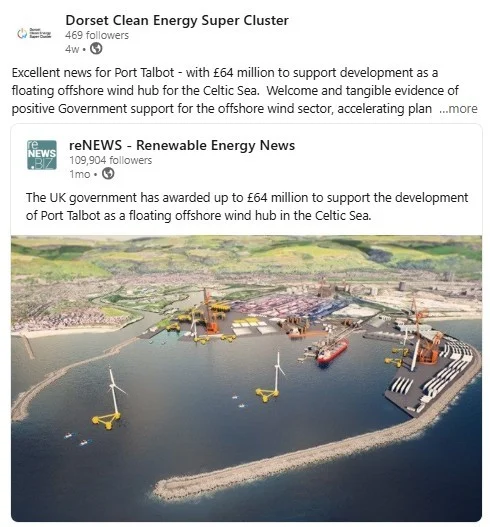
This provides a strong market signal and evidence of commitment to the renewables agenda and making a major step forward in delivering the clean power mission. The new port will help unlock at least 4.5 GW of floating offshore wind in the Celtic Sea – helping deliver clean, homegrown electricity, protect households from volatile fossil fuel markets and create up to 5,000 new jobs.
Expanding on these recent decisions, Claire Pearce, Strategic Director, Dorset Clean Energy Super Cluster says:
“The national announcements are positive news for the clean energy sector in the UK and firmly embeds the South of the UK in the country’s clean energy mission.
As a Cluster with a priority to establish Dorset as a new clean energy investment destination, it is encouraging to see the Government, TCE, NCC and NESO taking action to secure capability and align investment into the UK’s wind energy assets and supply chains to foster growth in the South. We recognise the critical importance of backing and developing UK assets, domestic supply chains and upgrading investment in grid infrastructure."
Collaborative progress
"The Cluster is collaborating with the private and public sector and with academia, to pave the way for a group of nationally significant clean energy infrastructure projects which will further strengthen UK clean energy capability, enhance energy security and resilience. We are pleased with progress to date. Acknowledging Portland Port as integral to the Celtic Sea Cluster offshore wind programme, a key port within the South West Multi-Ports Strategy and as a port that can be expanded to directly support offshore wind in the English Channel and other users."
Advancing energy transition in Dorset: OSW in the English Channel
"We have secured an offshore wind generation opportunity in the English Channel in The Crown Estate (TCE) Routemap, and our priority is to work with TCE to refine a project development area and to secure a leasing round to open up a competitive process at the earliest opportunity. This will directly stimulate UK asset and supply chain development, which can kick start inclusive training and employment opportunities in a deprived coastal community which has suffered from decades of deindustrialisation and severe jobs losses.
With one of the largest onshore oil fields in Western Europe and a former nuclear innovation site, Dorset has pivoted to advance transition into clean energy industries which now must translate into collective action to shape and implement pathways to delivery."
Accelerating a test-bed for multi-dimensional clean energy
"Increasing global instability, energy market volatility and enhanced need for UK security and resilience, means the Government must look to distribute and diversify its energy generating potential to all parts of the UK.
The South is a new frontier for Government to accelerate its strategic responses in its Clean Energy Mission. The Dorset Clean Energy Super Cluster can accelerate wind port development and a 2GW deep fixed offshore wind generation in the English Channel to power a new era of economic growth and transition - prioritising UK supply chains.
The Dorset clean energy opportunity offers the potential for a test bed opportunity and a multi-dimensional clean energy response with CCUS , hydrogen and nuclear opportunities ahead. It also offers Government a new chapter in its mission to establish the UK as a clean energy super power, boost growth and accelerate cross sectoral innovation to strengthen defence and secure critical infrastructure."