
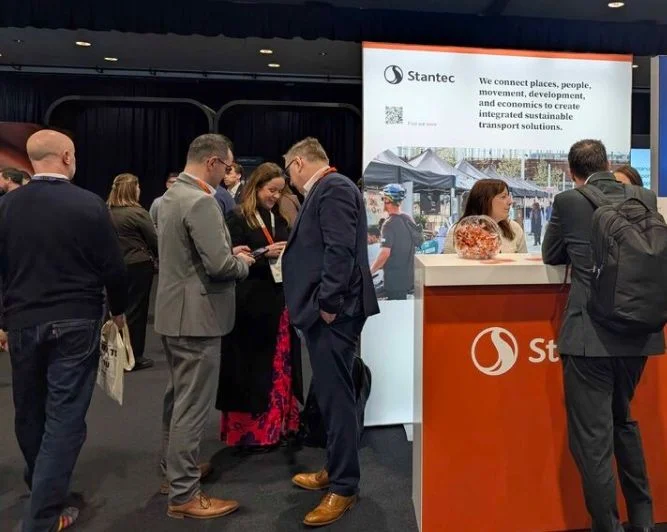
Reflecting on Interchange 26 in Manchester, the priority for place-led transformation and growth is clear. Whether city or region led, whether site or infrastructure asset led, investment must be shaped and integrated into place to positively contribute to long term sustainability, resilience, and prosperity of communities.
The transformation of cities such as Manchester is to be applauded, with regeneration and transport investment at its heart. Greater financial resources drive further development and growth to meet local and regional needs. Some challenge was offered regarding the relative merit of north -south rail investment in rail (HS2) versus east-west investment, and with hindsight, which would have provided the optimum impact in terms of economic growth. Strategic road improvements to tackle bottlenecks in the national network, such as the A303 improvement, have been dropped by Government with little consideration of the impact on the economy and national resilience.
For rural areas like the South West (SW), we need to adopt a different approach. Fragmented by a network of smaller cities, towns and villages, across multiple authorities, with nationally significant assets often in remote locations, the arteries – motorways, A roads, rail – that connect the assets are vital engines as well as enablers of growth.
The SW has a vital role to play in UK plc. When the two new nuclear plants are completed at Hinkley Point C, the SW will be producing 7% of UK energy needs to provide a vital baseload to compliment renewable sources, expanding on generating capacity beyond Hinkley B and complimenting oil production in Dorset over the next 10 years (the largest onshore oil field in Europe). The Celtic Sea will be a key source of offshore wind powering the UK and we expect The Crown Estate to unlock new opportunities in the English Channel to power clean energy transition in the South and open up future UK supply chain opportunities with Europe.
Home to one of the largest gigafactories in the UK, battery manufacturing has been kick-started by Agratas, a Tata owned company, to help decarbonise the UK transport system and support one of our prime automotive corporates, JLR in the Midlands, also Tata owned.
Let’s not forget defence, with the Royal Navy base at Devonport, Plymouth- the biggest base in Western Europe stretching across over 650 acres and over 4 miles of waterfront, home to 2,500 staff and supporting over 400 businesses. Surrounded by a wider network of defence companies across the region, including Leonardo helicopters in Yeovil – successful in their bids for the MOD new medium build helicopter contract- supporting over 3000 jobs in the SW and a further 12,000 in the supply chain.
Key national assets include the UK Hydrographic Office in Taunton, the Met Office in Exeter as well as our exceptional universities, ports from Bristol to Portland and beyond, and airports- with Bristol airport ambitions on sustainability and growth at the forefront to name but a few. The M5 operates as a critical asset for logistics and movement and supports economic growth as part of an innovation corridor from Bristol to Exeter. Add to that food production, some of the largest mineral quarries for natural stone and aggregate extraction for the country and we have quite a diverse contribution to make to UK plc.
I am sure I have missed many things, but you get my point. Often pigeonholed as just a rural destination – it has an exceptional natural environment with areas of national landscape and some of national or international significance. It has suffered from economic restructuring and de-industrialisation with Dorset, as an example, losing 8000 jobs over post war decades. Without industry there is no economic base, there are few opportunities for supply chains and limited choices for young people, leading to unsustainable trends which will result in a place withering slowly towards decline.
The SW is an important destination for investment. It will be more dispersed, centred on sites or assets, and must be connected to functioning strategic infrastructure, whether road and/ or rail, that will need to withstand seasonable demands or climate events to be resilient.
Whatever part of the UK we work or live in, growth is critical to generate employment and income to the Treasury and Councils to fund public services. Growth cannot be solely driven by cities. Investment cannot be focused on purely urban priorities. The UK, as a place, has to work in a global, competitive marketplace. Roads and rail across the country are arteries of growth, and strategically significant sites or economic assets in regions, such as ports, are economic drivers, locally, and also have undisputed national value.
There is an undeniable risk of unbalanced devolution in the UK and therefore inequitable growth, with a singular focus on Mayoral Strategic Authorities, largely in the North and the timetable for mayoral combined authorities in the South unclear.
As actors in the economic and planning sector, we need to acknowledge the context in which we all work: geopolitical unrest, a global marketplace, mobile international investment, uncertainty, climate events and disruption, limited national and local funds and the need to prioritise investment.
We can and must be proactive with grassroot, vision-led strategies for place with genuine market interest and realistic prospects of delivery, informing a region spatial framework. Collaboration across public and private sectors has never been so important.
We can underpin this by data and geographical information layers to inform National Infrastructure planning and infrastructure pipeline development. To get on the map we need to have a map! Otherwise the SW will be at the back of the infrastructure investment queue, swamped by city region demands.
If the defence strategy is seeking innovation at war time pace, why isn’t the economy or planning system getting the same treatment and why are we languishing in a sluggish and increasingly complex and outdated system which is not fit for purpose.
A fundamental necessity is streamlining of process, simplification of regulation, and action to establish progressive and enabling cultures in what is a complex and deeply bureaucratic planning system. Everyone is the system must play a part in unlocking growth and moving with greater agility and pragmatism to get stuff done. It’s why we get up in the mornings isn’t it?